The Democrats have won both Houses of Congress, which leaves President Trump facing a divided government for the next two years.
New legislation will need compromise, but the President can still act through executive orders, the veto and foreign policy.
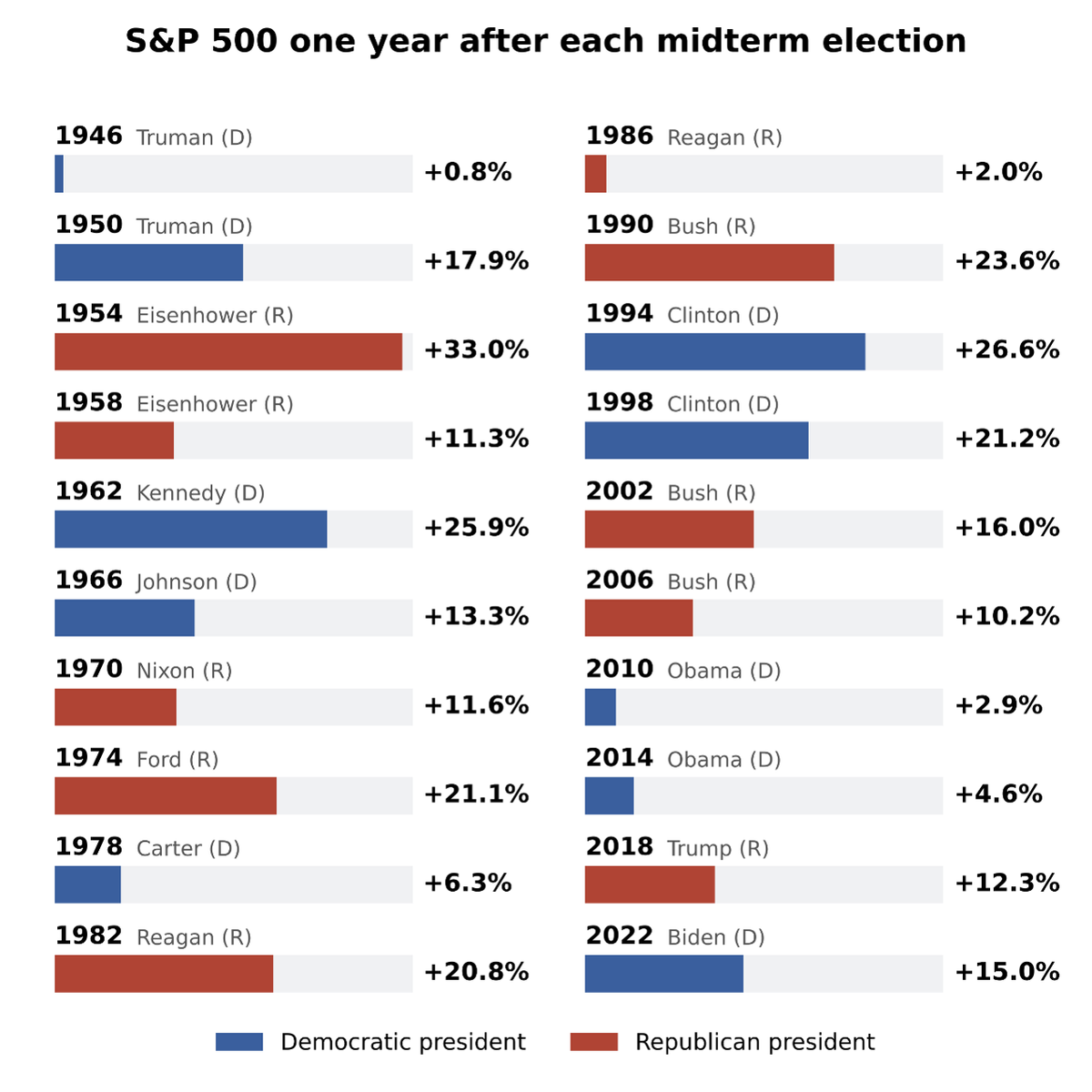
Since 1946, the S&P 500 has been higher one year after every midterm election, suggesting mid-terms rarely hurt markets over the medium term.
Democrats exceeded their most hopeful predictions in this week’s US mid-term elections. Viewed as a referendum on President Trump, the result appears to be a clear rebuke.
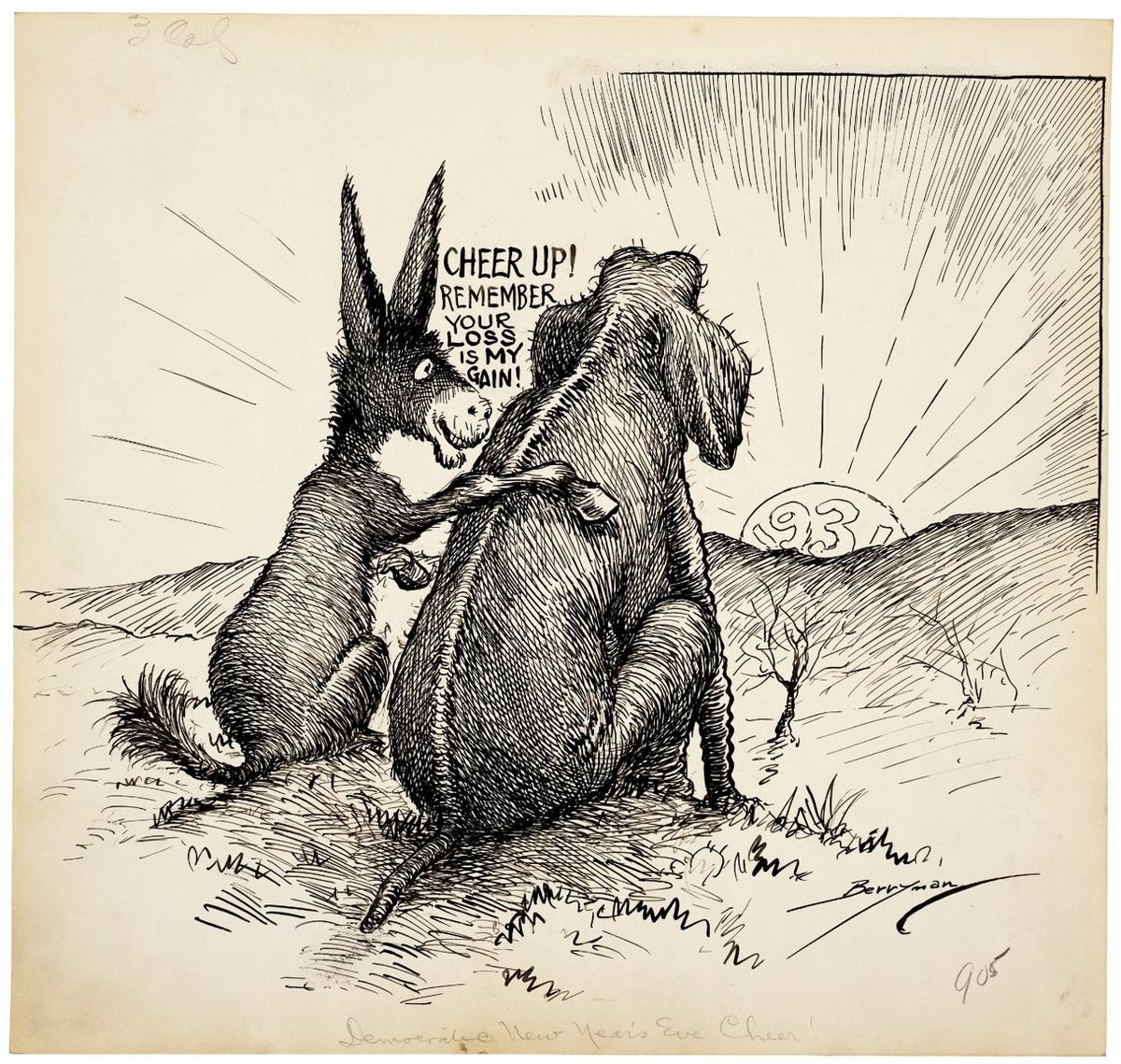
The cartoon above is from 1930, but could be published today, when a disastrous mid-term contributed to both Houses flipping from Republican to Democrat, eventually leading to two decades of unbroken Democrat government from 1933 to 19531.
Cheques and Balances
Congress has two chambers: the House of Representatives and the Senate. The House has 435 members, allocated by state population. Representatives serve two-year terms, so the entire House is elected every even-numbered year. All tax and spending bills must start in the House, which can also impeach federal officials, including the President.
The Senate’s 100 members, two per state, serve staggered six-year terms. It confirms presidential nominees, approves treaties by a two-thirds vote, and tries impeachments. Under the filibuster, most legislation needs 60 votes to advance.
To become law, a bill must pass committee and a vote in both chambers, which must agree identical text.
Mr Veto
The final bill goes to the President, who can sign or veto it. President Trump has referred to this as “the ultimate power” 2 which he will use as he feels necessary. However, Congress can override a veto with a two-thirds vote in both chambers – which they do not have in the Senate but may achieve in the House.
Divided we fall
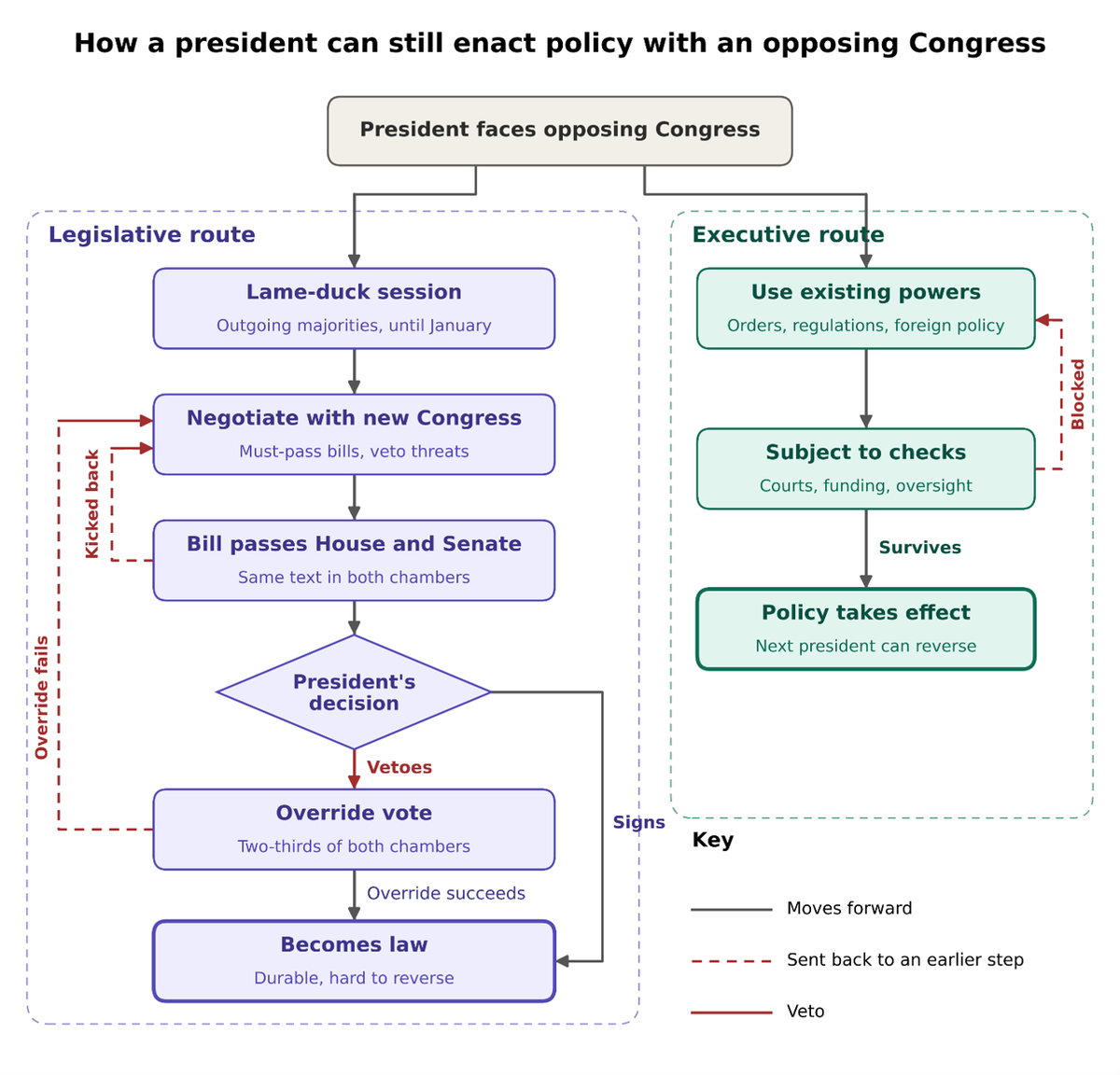
The US now has divided government, which is not uncommon as mid-terms often go against the President’s party. A President in this position can either work with the opposing Congress or pursue policy through executive action within the scope of presidential authority.
The new Congress takes office in early January; until then, the outgoing Congress keeps its majorities. In this “lame-duck” period, the president’s party often rushes through its priorities.
From January 2027, opposing majorities control which bills get voted on, so must-pass legislation, such as annual funding bills, becomes the main bargaining arena. Without a two-thirds override, both sides must compromise or accept gridlock.
Executive Decision
The President can also use executive orders to implement policy without congressional approval, direct agencies to rewrite regulations, set enforcement priorities, and conduct much of foreign policy, including sanctions and some tariffs.
Courts can block executive actions that exceed the President’s authority, and an opposing Congress can defund programs, hold hearings, issue subpoenas, and launch investigations. In the Senate, it can also block nominees.
The 1973 War Powers Resolution requires the president to end military action within 60 days unless Congress approves it, though binding limits can be vetoed. During the 2026 Iran conflict, Congress subsequently passed a resolution in both chambers seeking to restrict continued US military involvement3.
Market implication
Since 1946, the S&P 500 has been higher one year after every midterm election, averaging a 14.8% gain, even in the nine midterms where the president’s party lost control of Congress4.
Over the medium term, corporate earnings and economic growth matter more than election results.
Gridlock also makes sweeping changes to taxes, regulation, and spending less likely, reducing policy surprises. However, it raises the odds of shutdowns and debt-ceiling standoffs, which can rattle markets.
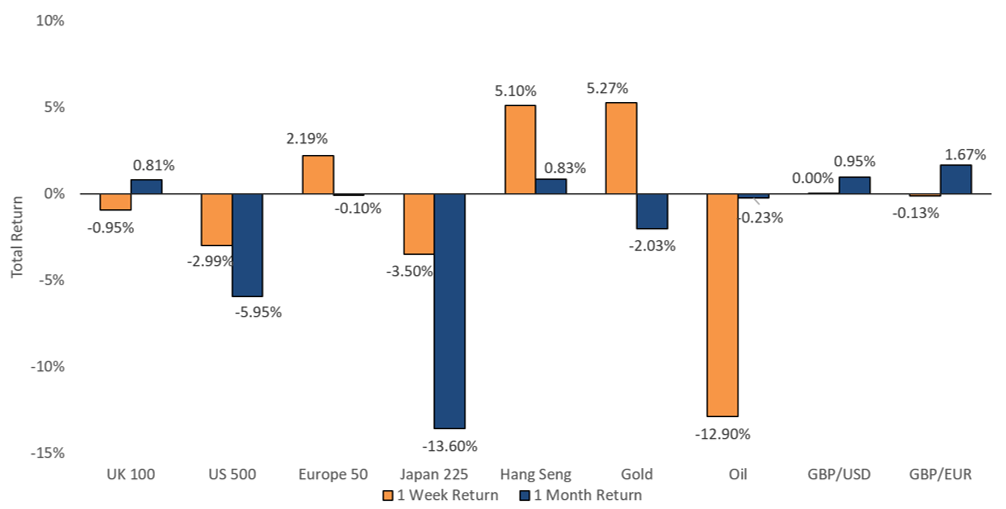
After an initial rally on Wednesday, Thursday saw the S&P 500 fall 4.36%, and the Nasdaq Composite drop 5.52%5, with similar falls recorded across Asian markets overnight. The falls were driven by worries the Democrats would use their power to more tightly regulate AI development and data centre construction6, compounded by some mixed corporate earnings results from two chip companies7 and a rapid, cascading unwind of positions in a crowded trade. At the time of writing (09:40 Friday 6th November) Nasdaq futures were pointing up 1.6%8 indicating some bargain hunters coming to the market and potential overreaction on Thursday.
Bowmore portfolios
For now, it is too early to tell what the lasting implications of this will be for markets. Oil prices have fallen quite considerably which is positive for most of the global economy and so far this year has supported stock markets, however more weight is being given to the AI-trade in current movements. Earlier in the year we made a sizeable pivot away from equities, particularly higher risk assets, into more defensive assets, such as Gilts, infrastructure and value-focussed funds, in recognition that the AI-trade may have become crowded. Within Core portfolios we rotated out of the S&P 500 index into the BNY US Equity Income fund – the former having a 40% tech weighting and the latter having only 15%9. Our trim to Japan, Emerging Markets and UK smaller companies had been redeployed into a low coupon 2028 Gilt which has protected capital, as expected, this week.
The value of your investments can go down as well as up, so you could get back less than you invested. Past performance is not a guide to future performance.
Sources:
1 The Presidents Timeline - White House Historical Association
2 Trump says he is prepared to use "tremendous powers" if Democrats take control - CBS News
4 Stocks After Midterm Elections: 80 Years of Data
5 AlphaTerminal
6 Wall Street Peers Into Abyss of AI Trade as Midterms Expose Risk - Bloomberg
7 Stocks plunge as AI worries crush tech shares
8 E-mini NASDAQ 100 (NQW00) Future Contract Prices & News - Google Finance
9 AMInsights