Whilst the S&P 500 sits near record highs, 38% of its constituents are already down more than 20% from their peaks, highlighting the growing disconnect between headline indices and the broader market.
An historic AI IPO wave could add to pressure on market liquidity. The enormous capital demands of SpaceX, Anthropic and OpenAI risk diverting investment away from the wider market, whilst valuations increasingly depend on ambitious growth assumptions. Anthropic’s upcoming listing could prove a pivotal test of investor appetite for AI.
We have reduced exposure to US technology and semiconductor-heavy markets, introduced downside protection and avoided the blockbuster AI IPOs. However, we recognise the transformative potential of AI and the risk of being underexposed if the rally continues.
The view from the top
The US’ main stock index, the S&P500, sits within 1.5% of its all-time highs1, an optimistic signal by any measure. However, at the stock level, a significant portion of the market is already in bear market territory2.
For example, look at the 50-day moving average, which is a widely used measure of a stock’s short-term health, with those trading above it generally considered to be in good shape and those below it the opposite. At present, only 42% of S&P 500 companies are trading above their 50-day moving average, meaning 58% are below it, and as of last Thursday’s close, 191 of the 500 companies in the index, some 38%, are down more than 20% from their highs3.
The index is telling a considerably more flattering story than the average stock within it, and understanding a key reason why that gap has opened up matters.
The IPO wave
Alongside recent wobbles in AI stocks, which have pulled back meaningfully from their highs in recent weeks, the market has been dominated by an extraordinary wave of past and upcoming initial public offerings related to the theme. SpaceX debuted on the Nasdaq in June, raising $86 billion at a valuation of $1.77 trillion, the largest IPO in stock market history4. Goldman Sachs, advising on the deal, told investors that revenues would need to grow from $18.7 billion last year to $474 billion by 2030 for the valuation to be justified, with the first profitable year not expected until 20315.
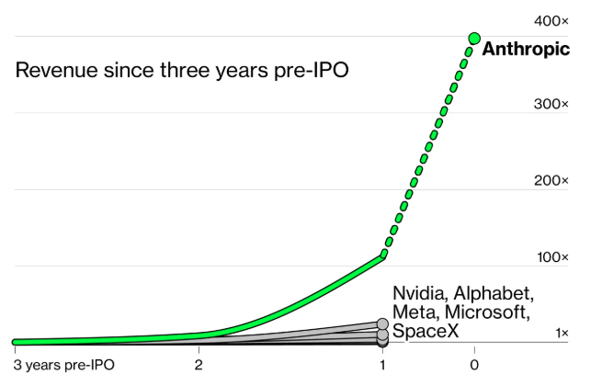
Further, Anthropic, maker of the Claude AI tool, has this week formally filed for a public listing, targeting a valuation of $2 trillion on the Nasdaq6. Following SpaceX, this would mark the two largest IPOs in history, back-to-back. Anthropic’s revenue reached $16.3 billion in the first half of 2026 alone, up from $1.2 billion a year earlier7. Against that, the company has disclosed $450 billion of spending commitments, the long-term infrastructure bill that sits beneath the headline revenue figures8.
OpenAI, which had been expected to list this year at a valuation approaching $1.4 trillion, has stepped back for now. CEO Sam Altman described a 2026 listing as “ill-advised”, and investor appetite has been so meek that the company has since been forced to revise its target valuation down to $1.25 trillion9.
Where the money comes from
The scale of capital these listings demand is without precedent. SpaceX , Anthropic and OpenAI are together expected to place significant demands on investor capital across 2026 and into 2027, to say nothing of the extra tens of billions in extra issuance from the likes of Meta and Alphabet, a figure that exceeds everything raised across the entire dot-com boom and in any year since10.
Fortune magazine put the issue succinctly, these IPOs “could reopen the market, or drain it” ¹². When listings of this scale arrive, especially back-to-back, institutional investors accumulate cash in advance of expected allocations, retail money gravitates towards the new and the exciting, and capital that might otherwise have found its way into more traditional companies, international markets or less flashy asset classes sits waiting. These blockbuster IPOs act like a black hole, pulling liquidity from across the market and concentrating it in a handful of companies. We believe this may be one factor contributing to market dislocation, though it is not the only one; rising yields, broader macro pressures and wobbling sentiment are all contributing.
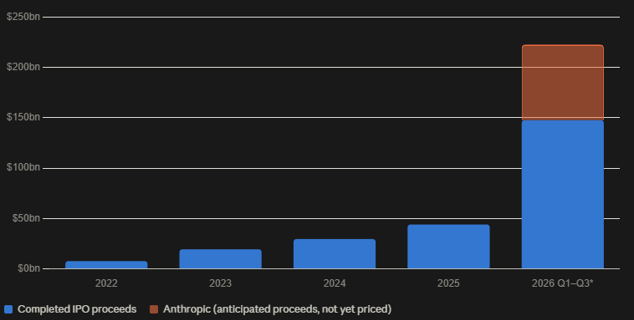
In supporting the AI trend, liquidity in the broader market appears to be squeezed, supported by business valuations that require assumptions that are ambitious at best.
Anthropic’s IPO is being treated across Wall Street as a referendum on the current prospects for AI11. If it is well received, the trend extends. If it is not, an index trading near its highs whilst 38% of its constituents are already down more than 20% from their own peaks has considerably less support than the headline index performance suggests.
Bowmore portfolios
Through 2026 we have reduced our exposure to the AI trade’s specific risk, selling out of US equal weight indices in favour of value-tilted traditional equity income funds, trimming Emerging Markets and Asia given their domination by semiconductor companies, and introducing more structured product funds for downside protection. We remain meaningfully underweight US equities and technology relative to peers, and neither we nor our underlying managers participated in the SpaceX IPO, nor do we intend to for Anthropic or OpenAI.
That said, the underlying businesses generate extraordinary cash flows, and the technology itself, if even a fraction of the bull case proves correct, has the potential to be utterly transformative. To sit entirely outside that would be to risk missing the most consequential investment theme of a generation. We are watching the Anthropic listing closely, and will keep you updated as events develop.
The value of your investments can go down as well as up, so you could get back less than you invested. Past performance is not a guide to future performance.
Sources:
Trading Economics
International Business Times
International Business Times
Bloomberg
Financial Times
Anthropic S-1 filing, October 2026
Wall Street Journal
Globe and Mail
Financial Times
Reuters, Axios, Investing.com
Fortune