• Jensen Huang, the founder and CEO of Nvidia, resigned on 12 November after 33 years.
• The exit followed a board investigation into Mr Huang’s personal conduct and an affair with an alleged Chinese spy.
• For investors, the bigger issue is succession with Huang deeply involved in the firm’s innovation. The stock was down almost 15% between Wednesday and Thursday this week.4
A founder, not a figurehead
Jensen Huang co-founded Nvidia in 1993 from a Denny’s restaurant and ran it for 33 years. Under his leadership, a maker of graphics cards for video games became the dominant supplier of the chips that power artificial intelligence, with an estimated 90% share of the market for high-powered AI data centre chips.1 In October 2025 it became the first company to reach a $5 trillion market value,2 and through 2025 it made up around 8% of the S&P 500, the largest weight for any single company since 1974.3
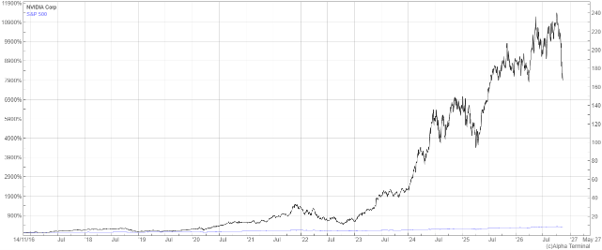
The scale on the left, vertical-axis is not a mistake. For the 10 years to 6 October 2026, the stock was up over 10,000%. To put this into perspective, the main US stock market is charted in blue and, despite being up over 320% in the last 10 years, looks almost flat in comparison.
Supposedly, Jensen was also unusually hands-on for the head of a company this size. It is said that the CEO had about 60 people directly reporting into him as opposed to one chief operating officer. He played a central role in strategic and technical decisions.
What it means for investors
In the short term, markets have reacted nervously. Shares were down almost 10% from peak to trough on Wednesday 11th November following the initial reports that Jensen Huang was having an affair with an alleged Chinese Spy.4 The company saw a brief rebound in its share price on Thursday, however, with Jensen having been ousted by the board, the share price is down another 3% on Friday (at the time of writing). Nvidia reports quarterly results on 17 November, its first ever without Mr Huang, so the market will be listening closely to how interim CEO, Colette Kress, and the board describe the product roadmap and customer commitments.
The longer-term picture depends less on one individual than on whether the machine he built can run without him. Demand for AI chips does not leave with a CEO. However, the board does now have an almighty task in choosing a new permanent leader. Whoever it is, we anticipate a new organisational structure at the firm, with product as the centre of gravity instead of one person.
Bowmore portfolios
We have a very small weighting to Nvidia in portfolios, making up less than 1% in a Risk Profile 5 portfolio. We took profits on US tech, reducing our weighting to Nvidia, at the start of 2025 and then again halfway through 2026. There’s no denying their central role in AI and the semiconductor supply chain, nor do we think this has dramatically changed this week, but we were already cautious on the firm’s valuation and preferred to get our AI thematic exposure at lower valuations through the Emerging Markets.
The value of your investments can go down as well as up, so you could get back less than you invested. Past performance is not a guide to future performance.
Sources:
Fortune – Nvidia’s power is built around Jensen Huang (9 November 2026)
Fox Business – Nvidia first company to hit $5 trillion (October 2025)
Benzinga – Nvidia now represents 8% of S&P 500 (October 2025)
Alpha Terminal, Bowmore Asset Management