Important information: The value of investments and any income derived from them may go down as well as up. You may not get back the amount originally invested. Past performance is not a reliable indicator of future results.
• When privatised in 1989 under Margaret Thatcher’s conservative government, Thames Water had no debt – it now has £14.7bn worth in loans, c.80% of the whole business
• An estimated 585 million litres are leaked from Thames Water pipes a day, roughly 234 Olympic swimming pools
• Kemble, the parent company of Thames Water is officially insolvent having defaulted on the interest payment of a £400m loan
From this years Boat Race’s unique safety warning to avoid the water for risk of E.coli to pipes in Finsbury Park just being replaced from when Queen Victoria was our monarch, the problems facing Thames Water are formidable. Not only is it drowning in debt, but it’s also not providing a good enough service – and in the last year has been fined over £100m by Ofwat (the water regulator).
A large proportion (£11bn) of the debt was built up during the 11 years it was owned by the Australian investment bank Macquarie and in that time they paid out £2.7bn in dividends – but higher interest rates in the last few years have caused it to balloon further as c.60% of it is index linked.
Thames Water turned to its international shareholders to find the necessary funds (c.£1bn) to service its debt last year and an agreement was struck that support would be provided, but this was crucially subject to Ofwat setting the allowed returns at a level that ensured the investment's viability to shareholders. In a turn of events, this condition was not met in late March, rendering the business uninvestable by its shareholders.
With a poor environmental and social reputation of leaks, sewage contamination and executive pay only making matters worse – the business may only have a few viable options to stay afloat.
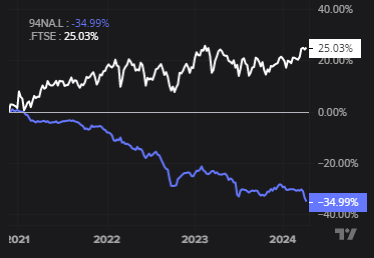
Thames Water vs FTSE 100 over five years