
Important information: The value of investments and any income derived from them may go down as well as up. You may not get back the amount originally invested. Past performance is not a reliable indicator of future results.
Welcome to this quarter's Three Charts in Three Minutes, our quick look at what has been moving markets in recent months.
In this edition, we look at why markets expect oil prices to ease after a turbulent third quarter, how central banks have changed their stance on interest rates, and why company earnings, rather than sentiment alone, have been driving share prices.
Markets expect oil price to fade+
Source: Artemis UK Select, September 2026
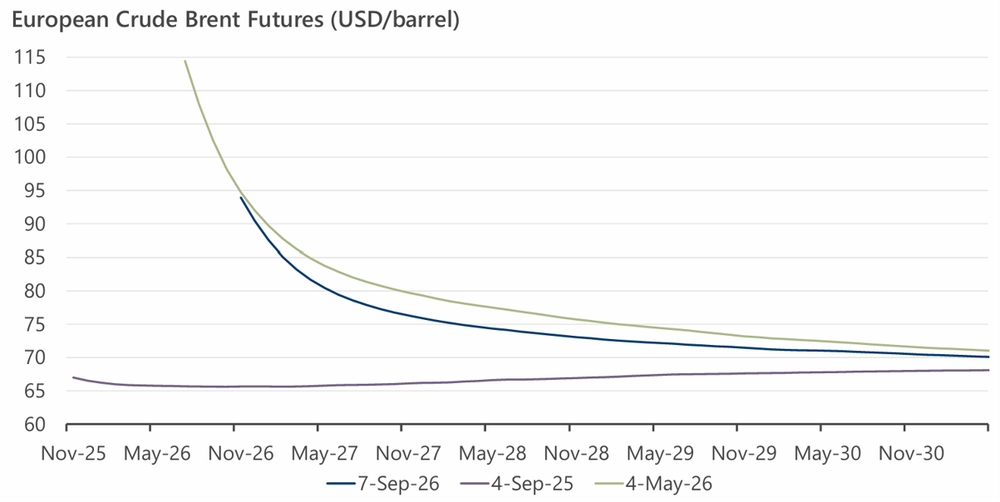
• Oil was the big story of Q3 2026. Prices rose by roughly 30% as global oil markets tightened, and energy stocks were the strongest performing1. Brent Crude averaged over $90 per barrel in August, compared to $83 in July as exports out of the Middle East remained disrupted.
• However, the above chart for Oil Futures shows that oil is expected to be back down at $85 / barrel by the end of 2026 and continue to head towards $70 / barrel through 2028 and 2029.
• There are a number of factors that could be driving medium term energy prices down: Iraq and Venezuela have huge untapped oil reserves, the UAE has left OPEC, strong growth in LatAm production, and acceleration in the electrification of the global economy.2
• We expect oil prices to remain volatile in the near term, given the ongoing conflict in the Middle East, however, we do not expect a prolonged period of high oil prices. We think this is a short term supply shock that should ease over the next couple of years and help bring inflation back down.
1First Financial Trust, Quarterly Market Review September 2026
2Artemis UK Select September Update
Central Banks: A change of tune+
Source: HSBC Market Outlook, August 2026
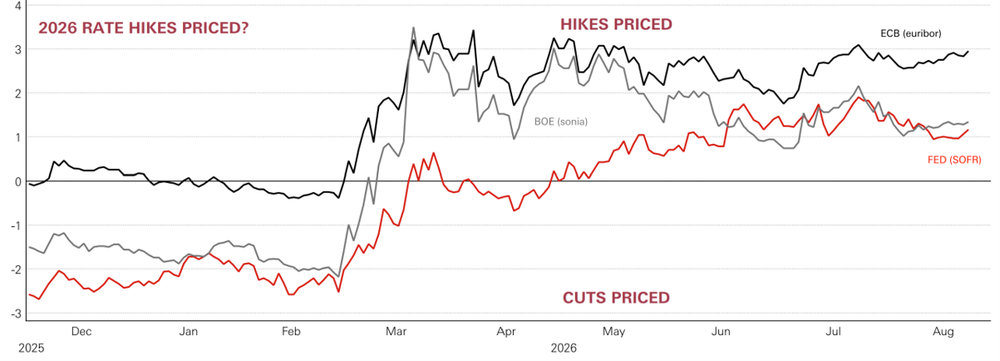
• At the start of the year, the debate was about how quickly interest rates would fall. A resilient labour market, energy-driven inflation, and strong economic growth have flipped that outlook to how many rate hikes will we get.
• Eurozone inflation is expected to come in at 3.8% in September, the highest since September 2023, with energy costs doing most of the work. Meanwhile, US inflation remains well above target reading 3.4% in August, and UK inflation rose to 3.1% in August, up from 2.9% in July and 2.6% in June.3
• In September, the Fed raised rates by 0.25% to 4.00%, its first increase since 2023. The ECB hiked rates to 2.50%, its second hike of the year. The Bank of England actually deviated from the other central banks, opting to hold rates at 3.75%. It was close though with 6 votes for holding and 3 for hiking to 4%. The Bank warned that the longer energy prices stay high, the greater the risk of more persistent inflation.4
• Rising interest rate expectations hit bond values hard. The US 2-year Treasury yield shot up dramatically from 4.4% to 4.9% in September whilst the UK 30-year gilt yield tops 6%, its highest level since 1998.5
• Starting yields are now the most attractive in nearly two decades.6 We expect continued volatility ahead with no sight of an immediate resolution in the Middle East, and of course the upcoming UK budget. However, there is now a meaningful income cushion against further price moves. If oil eases as the futures market suggests, inflation should follow, and we could return to a cutting cycle.
3JPMorgan Guide to the Markets, Inflation
4Bank of England, September 2026 Update
5Reuters, UK 30 year gilt yields top 6%
6CNBC, 10-Year Treasury Yield
Earnings are driving the market+
Schroders Equity Lens September 2026
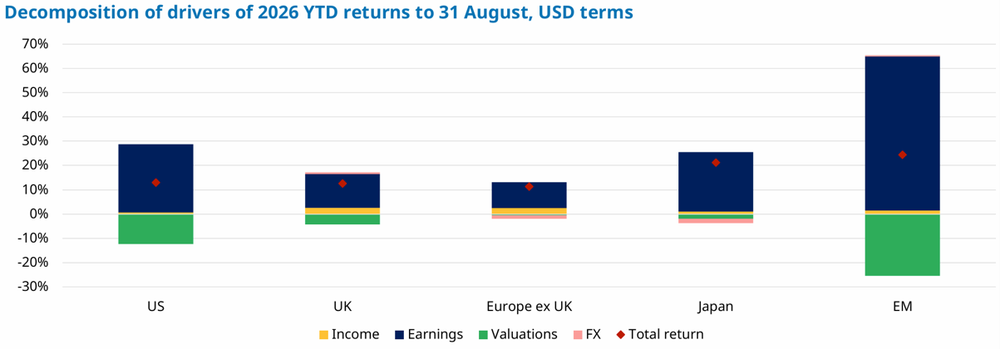
• Despite higher oil prices and rising rates, the S&P 500 reached record highs in August, supported by strong AI earnings and forecasts.7 The above chart shows the breakdown of drivers of stock market performance in 2026 and that it is earnings pushing up share prices not just valuations (sentiment). In fact, the US stock market is cheaper now than at the start of the year relative to its earnings (a forward P/E of 20 at the end of August 2026 vs over 22 at the start of the year).8
• Earnings have strong positive momentum too and we are seeing an increasing number of earnings upgrades across all of the US, UK, Europe, Japan and EM.9 At the same time profit margins have been trending upwards around the globe to the highest level they’ve been in two decades.8
• Big tech companies like Microsoft, Amazon, Alphabet, Meta, and Nvidia are all trading at cheaper valuations than their average over the past decade despite all their share prices rising this year.9
• One of the key things we’re watching is AI monetisation as this needs to start growing to warrant the capex of the sector. To that end, cloud revenue is finally starting to accelerate across Microsoft, Amazon and Google; Microsoft's Azure cloud business topped $100 billion in annual revenue for the first time.10
• Strong earnings are obviously encouraging for us as investors, but with that comes even higher expectations. Q3 reporting season starts in mid-October and will test whether these high expectations can be met.
7Reuters, S&P 500 hits record high, August 2026
8JPMorgan Guide to the Markets
9Schroders Equity Lens September 2026
10Yahoo Finance, Azure topped $100 billion in annual sales