The record breaking Anthropic IPO reignited concerns over the scale of AI investment and whether the industry can generate sufficient returns to justify its spending. Those concerns drove a sharp global sell-off on Friday, with the Nasdaq falling 5.3%, before markets partially recovered on Monday morning.
Our portfolios protected well during Friday's sell off. Recent defensive positioning, diversification across asset classes and regions, and lower exposure to large technology companies contributed to resilience.
We remain cautious, prioritising diversification and capital preservation over chasing a quick rebound. We continue to review portfolios for opportunities to reduce volatility further, including the potential addition of broad-based commodity exposure, while monitoring developments closely.
What happened in markets last week?
Global stock markets fell sharply on Friday, and many of you will have read about it over the weekend. Below we set out what happened, how your portfolio has performed and how we are responding. In brief, our portfolios protected well, and markets have stabilised to some degree this morning.
The sell-off followed the stock market debut of Anthropic, one of the leading developers of artificial intelligence. It listed on the Nasdaq on Thursday 19 November, raising approximately $93.5bn at $83 per share1 in the largest flotation on record, and closed its first day 17% higher2. However, that sum is modest compared with the spending plans across the industry. Anthropic has committed around $901bn to computing power and data centres over the coming years3, and SpaceX, which floated in June, has raised tens of billions in equity and debt for new data centres4. Amazon, Alphabet, Microsoft and Meta will spend over $700bn between them this year alone, roughly double last year5. Investors have long worried that these sums may outstrip the industry's ability to profit from them.
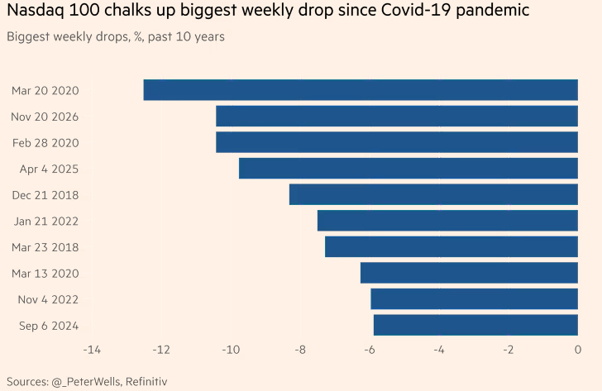
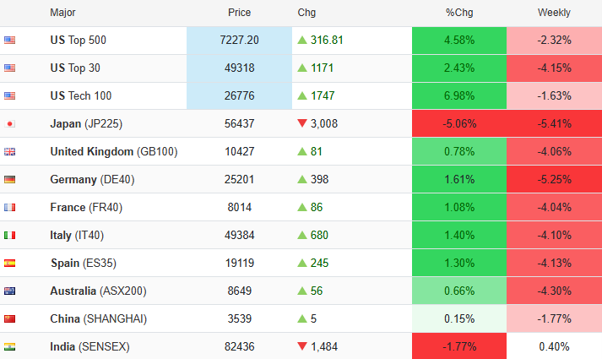
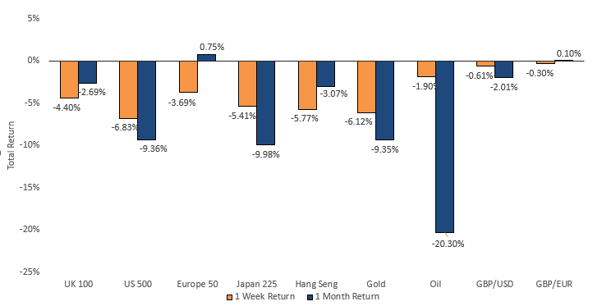
That worry has unsettled markets several times this year. Falls in March, and later in June, both proved short lived, but since the Nasdaq (the US’ tech index) peaked on the 6th of October the pressure has been more persistent6. Those concerns came to the fore on Friday, the day after Anthropic's listing, when its shares fell 8.5% and the Nasdaq 5.3%7, rounding off the Nasdaq 100's worst week since the Covid sell off in March 20208. The selling pressure spread around the world, with Japan and South Korea down more than 5% and even the UK's FTSE 100, which has little exposure to AI, down 1%9, as investors moved into cash and government bonds10.
The worst of the selling came just before the weekend, and with markets closed a degree of calm has returned. As of Monday morning, futures on the Nasdaq 100 were up around 3% and on the S&P 500 around 2%, and European markets have opened modestly higher11. The Nasdaq leapt further still following the reinstatement of Jensen Huang at Nvidia2. Asia has been more mixed, with Japan closed for a public holiday and South Korea falling further despite steps by authorities in the region to support their markets13.
How have the portfolios performed?
Our portfolios are designed to hold up in periods of market stress by combining equities (shares) with bonds, alternative investments such as infrastructure, and cash, so that weakness in one area can be partly offset by strength in another. Moreover, in recent months we have also made a number of changes to position portfolios more defensively, reflecting the growing pressure in markets from AI spending, the inflation brought on by the war with Iran, and the high level of government borrowing around the world.
These changes have meant our portfolios have protected well relative to the global stock market index. Core 7, our highest risk portfolio, which is invested almost entirely in equities (shares), outperformed the global stock market index by 1.5% on Friday14, and as each step down our risk scale holds progressively less in shares, Core portfolios 3 to 6 were better protected still15. Our ESG portfolios performed better again, as they hold less in large technology companies, and our Passive portfolios, which are designed to track global markets closely, fell by less than the market itself because of our asset allocation decisions16.
Government bonds rose in value on Friday as share prices fell17. Bonds often move in the opposite direction to shares during periods of stress, which is one of the main reasons we hold them. Gold, meanwhile, fell 4.6% to its lowest level in more than a year, before regaining some of this loss on Monday18. We have not held gold at all this year or last, as we felt it no longer offered the protection it has historically provided in falling markets.
What next?
We have taken a cautious approach to markets for some time, and that approach has helped to protect portfolios over recent weeks. Reducing risk after a strong run meant accepting that we might miss out on some further gains, but we judged it necessary to protect the excellent returns our portfolios had achieved earlier in the year.
The fund managers we speak to each week are considering the same question of what comes next, and with several sources of strain in markets at once, the range of possible outcomes is unusually wide. We believe the most sensible course is to continue holding well diversified portfolios with many different, independent drivers of return across regional stock markets, bond markets and alternative investments. We are not looking to chase a quick rebound, and are considering further changes to reduce volatility. With commodity prices having fallen in recent weeks, we are also considering adding broad based commodity exposure. We continually reassess our own views, and those of our peers, to make sure nothing is missed.
We will keep you informed as events develop. If you have any questions about your portfolio, please do get in touch with your investment manager by phone or by email.
The value of your investments can go down as well as up, so you could get back less than you invested. Past performance is not a guide to future performance.
Sources:
CNBC
TradingView
Anthropic S-1/A
Wall Street Journal
Forbes
Trading Economics
CNN
Financial Times
Trading Economics
CNN
Trading Economics
Financial Times
Yahoo Finance, Bloomberg
AM Insights
AM Insights
AM Insights
Trading Economics
Trading Economics