Chinese AI models are catching up with US AI models at a quickening rate
Modest impact on economic growth for now, but short-term boost anticipated from electronics manufacturing
Early signs support Bowmore portfolios’ diversification away from the US into Asia
When DeepSeek emerged from Hangzhou, China, in early 2025, it sent shockwaves through the Western tech market. Nvidia lost close to $600bn from its market cap, whilst US chipmaker Broadcom fell 17%[1]. Then it seemed to disappear.
A bottleneck in computing power forced DeepSeek to delay new models, focusing instead on refining existing ones.
Meanwhile, US models kept evolving. Open AI closed a $122bn round of financing at a share price that indicated a $852bn valuation for the firm on 31 March 2026[2]. Anthropic raised $65bn at a $965bn valuation on 28 May 2026[3], before releasing its disruptive Fable & Mythos 5 models on 9 June.
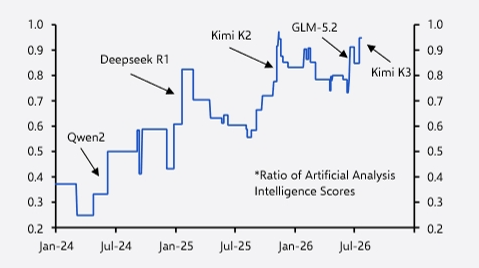
All was quiet on the Eastern front until Moonshot AI released Kimi K3 on 16 July 2026. This Chinese free-to-use rival outperformed Claude’s Fable 5 and OpenAI’s GPT 5.6 across a number of benchmarks, dragging attention back to Chinese AI labs[4].
Adoption was another constraint, until recently. Downloads of Chinese models grew to 663 million in the year to February 2026; with monthly downloads now exceeding 180 million[5]. Airbnb and Siemens are among established companies known to be using Chinese models for their global operations[6].
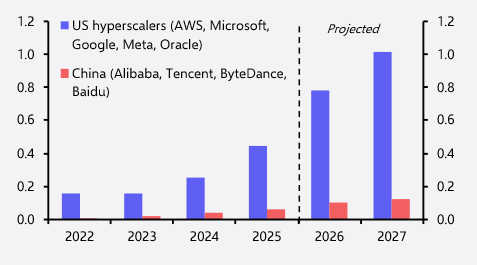
How close is China to taking the lead? There’s some way to go yet, with the biggest obstacle being access to “compute”, the computing power used to train models. Independent studies estimate US companies have access to 5-10 times more, with far better access to the most powerful chips[6] . US firm’s capital expenditure (capex) in the space is approximately eight times higher than China’s[7].
The Chinese system runs less efficiently at the hardware level, needing more energy, more chips, and larger data centres to keep pace[6].
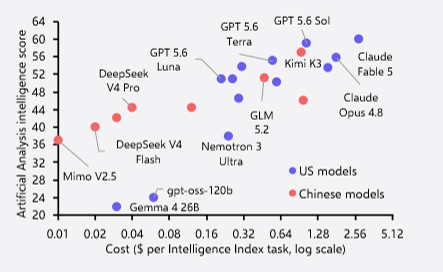
What lets them keep pace is efficiency of a different kind; Chinese models are built to do more with less, at broadly much lower training costs[6]. And because US labs have pushed the frontier, Chinese labs have been able to learn from the models ahead of them.
Kimi K3 is an early insight into what is possible when investment approaches US levels: estimated to be only 10% cheaper than comparable US models yet delivering similar intelligence[4].
Market impact
The main threat is to the likes of Anthropic and OpenAI, as Chinese models are expected to remain opensource i.e. free to access[6] . US firms, however, can reinforce their moat through established commercial ties with US hyperscalers. Even if Chinese models crack the US market, they would still be reliant on using hyperscaler’s local infrastructure.
The real impact will be on the local market.
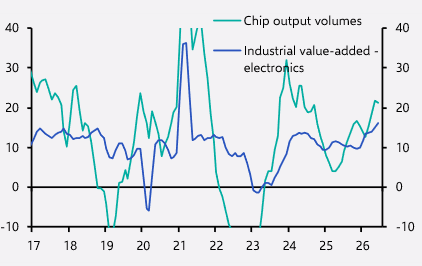
Even if the US restricts access of their models to the Chinese market, domestic models will ensure firms and consumers retain access to leading models. Boosting compute will require further investment and this is already being driven from the very top. China’s electronic production has already seen a spike in recent months[8]:
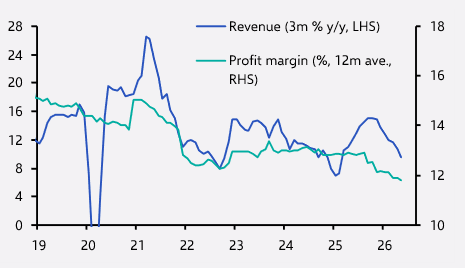
There has been limited evidence of an AI boost to IT services financials so far, unlike in the US where the sector has already seen an impact. This is an area that could see near term productivity and cost benefits [8].
Parallels can be drawn between AI model evolution and the countries’ respective equity markets. The S&P 500 is trading at c.26.4x earnings, above its long term average of around 25.4[9], with a need to continue innovating to push growth. China, in the meanwhile, is trading at c14.8x earnings against a long term average of around 13.2x[10]. This discount reflects real risk, historically stemming from policy and access. Domestic AI could be the catalyst to reduce the gap.
Bowmore portfolios
Bowmore portfolios already carry exposure across both Chinese technology and infrastructure, for example within Matthews China Innovators, which is held in our portfolios and has returned c.25% YTD[11] (past performance is not an indication of future performance).
Cheaper to build, cheaper to use, and cheaper to own. Much like the AI market, the China equity story is hard to ignore.
[2] OpenAI raises $122 billion to accelerate the next phase of AI | OpenAI[HW1]
[3] Anthropic raises $65B in Series H funding at $965B post-money valuation \ Anthropic
[HW2] [4] Artificial Analysis, Capital Economics
[5] Hugging Faces, Capital Economics
[6] Capital Economics
[7] Goldman Sachs, Alphabet, Capital Economics
[8] CEIC, Capital Economics
[9] S&P 500 PE Ratio: 26.353 (Aug 2026) — Historical Chart & Data | GuruFocus
[10] CEIC
[11] Morningstar
The value of your investments can go down as well as up, so you could get back less than you invested. Past performance is not a guide to future performance.