
· Incoming Chancellor, John Healey, inherits gilt yields above 5%, their highest since 2008 and steepest climbing in the G7, whatever fiscal headroom Reeves rebuilt now likely eroded by the Iran conflict, and relentless pressure to fund defence alongside a welfare and pension bill that keeps growing.
· Every avenue is largely blocked; the tax burden is at a post-war high and the experts have warned against more, the gilt market punishes any hint of extra borrowing, and the obvious spending cuts have repeatedly proved politically impossible.
· We continue to distinguish the British economy from British companies; with over 80% of FTSE 100 revenue earned overseas and the index weighted towards resilient old economy names, our UK allocation keeps cushioning portfolios and adding to returns when other markets falter.
Britain has a new Prime Minister. Andy Burnham was asked by the King to form a government on Monday, becoming the country's seventh Prime Minister in ten years[1]. The greater surprise came at the Treasury, where Burnham handed the Chancellorship to John Healey, a choice almost nobody had foreseen. Markets had braced for Ed Miliband and a lurch leftwards in policy, so many investors greeted Healey's appointment positively[2]. He is, in the familiar mould of British politics, a career politician[3]. However, he did earn genuine plaudits last month for standing down as Defence Secretary rather than sign off on the Defence Investment Plan, having spent months at loggerheads with the Treasury over funding for Britain's badly neglected armed forces[4]. He now finds himself running the very department he fought so long against, unsuccessfully. A new face, then, but will anything actually change?
The issues before the Chancellor
Rachel Reeves left office having rebuilt a sliver of fiscal headroom, the margin by which the government expects to meet its own self-imposed borrowing rules[5]. However, the Iran conflict has driven energy prices sharply higher, feeding through into inflation and forcing a wholesale repricing of interest rate expectations. Weaker growth means lower tax receipts, higher inflation means costlier debt servicing, and the headroom Reeves tentatively achieved may no longer exist. Healey therefore arrives not to a clean slate but an inheritance of his forebear’s problems.
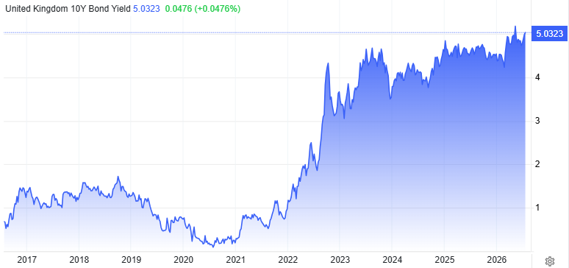
Nowhere is the pressure more visible than in the cost of government borrowing, The yield on the 10-year gilt, effectively the interest rate investors demand to lend to the government, has been hovering above 5%, its highest level since 2008. That is amongst the highest of any developed nation, and it has climbed faster than any peer[6]. For a government whose day-to-day spending exceeds its tax revenue[7], this makes the act of financing itself materially more expensive. The market is pricing two anxieties; entrenched inflation, and a suspicion of the sort of fiscal looseness that a country as indebted as the UK can ill afford[8]. Burnham learned this quickly - having made some rather bold remarks about bond markets, he has since been careful to walk them back, publicly committing to abide by Reeves' fiscal rules[9].
Yet the pressure to spend is relentless. Burnham's opening policy is to cut VAT on energy bills, alongside promises of broad cost-of-living support, the nationalisation of companies such as Thames Water, an expansion of affordable housing, and continuation of the unaffordable triple lock[10].
Set against all of this is the issue that Healey has become most known for. Despite a modest, and as yet unfunded, uptick in spending announced earlier in the month, Britain's armed forces remain their smallest and comparatively weakest in hundreds of years[11], a malaise from the Cold War peace dividend the UK seems unable to shake off.
On paper, the government is committed to lifting defence spending from around 2.6% of GDP towards 3.5%[12]. The trouble is that every route to paying for it appears blocked. Some commentators have cautioned against further tax rises given their increasingly smothering effect, and the UK already collects more tax as a share of GDP than the developed-world average[13]. Burnham has, in any case, pledged to honour the manifesto commitment not to raise the headline rates of income tax or capital gains[14]. Other levies, National Insurance chief among them, have been cited by commentators as a leading factor in weak youth employment[15]. Borrowing, as we have seen, is punished by the gilt market.
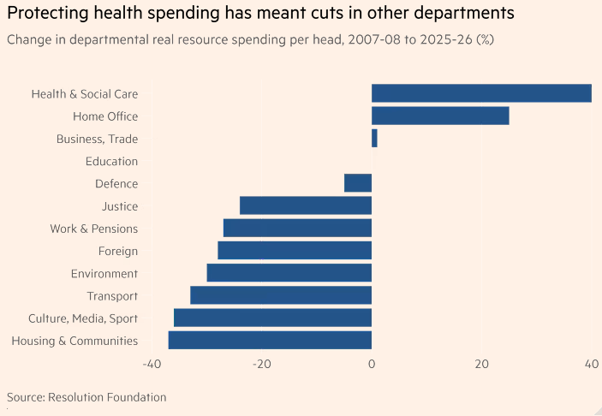
That leaves spending reform. Health, welfare and the state pension already absorb close to half of all government spending, with health alone accounting for almost £1 in every £5 spent, and the welfare bill already outstrips the total income tax take and has climbed well over £300bn[16], whilst the triple lock, long-considered an acute fiscal pressure by the government’s own Office for Budget Responsibility[17], remains politically untouchable. This juggling act must be performed against a backdrop of widening youth unemployment, geopolitical instability in the Middle East and spiralling inequality. It is not an easy job, and the rubber will have to meet the road before long. Expect Burnham's honeymoon period to be extremely short, just as Starmer's was, grappling with the same problems, the same constraints on political capital, and the same limited arsenal with which to confront them.
Bowmore portfolios
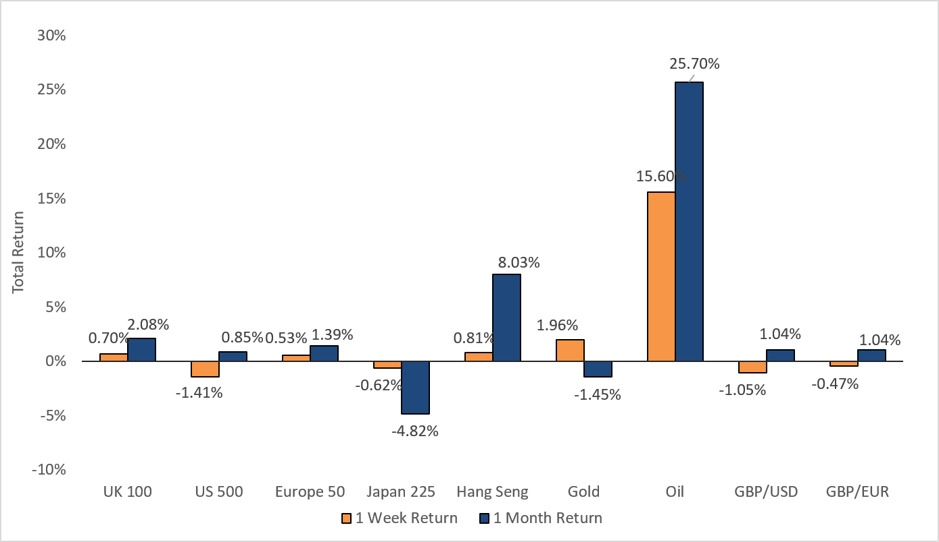
Given all of this, one might ask why our portfolios retain a significant allocation to the UK, at 14.5% in our mid-risk portfolio. Here we would stress difference between UK companies and the UK itself. Whilst the domestic economy limps on, British companies are thriving. The overwhelming majority of FTSE 100 revenues are earned overseas[18], and earnings have been strong and are growing. Just as importantly, the UK market carries a profile quite unlike its peers in Europe and the US, weighted towards "old economy" sectors such as banks, energy, miners, defence and industrials, where global indices elsewhere are dominated by large, growth-oriented technology companies. In a portfolio context that difference adds considerable value, helping to reduce volatility and to contribute to performance when other markets falter, andthe Iran conflict has recently illustrated this diversification benefit. We cannot ignore the UK's increasingly thorny fiscal position, but our confidence in British business, rather than the British state, remains undimmed, and well-rewarded.
[1] CBS News
[2] RTÉ
[3] Wikipedia
[4] The Conversation
[5] Office for Budget Responsibility
[6] Trading Economics
[7] ONS Public Sector Finances, via Luke Evans MP
[8] City AM
[9] Bloomberg
[10] The Independent
[11] Full Fact
[12] Institute for Fiscal Studies
[13] The Telegraph
[14] Euronext Markets
[15] Bloomberg
[16] Institute for Fiscal Studies, The Telegraph
[17] Office for Budget Responsibility
[18] Investing.com
The value of your investments can go down as well as up, so you could get back less than you invested. Past performance is not a guide to future performance.