

There are currently 24 takeover bids in progress on the UK stock market. (1)
This month, 3 UK-listed companies accepted takeover offers on the very same day. (2)
Since 2023, £165bn of UK market value has been bid on, replaced with only £6bn in new listings. (3)
With takeover activity in the UK stock market continuing at pace, and indeed three UK-listed companies (Rotork, Gooch & Housego and Ramsdens) recommending bids on the very same day recently, we thought it would be timely to explore why the UK has become such an attractive hunting ground for acquirers. Bids are running into extreme multiples, for example Rotork’s was at a 73% premium to its market cap, EasyJet at 80% and Schroders at 34%4. This week, we examine factors behind the wave of takeover interest and why UK-listed companies continue to represent compelling value.
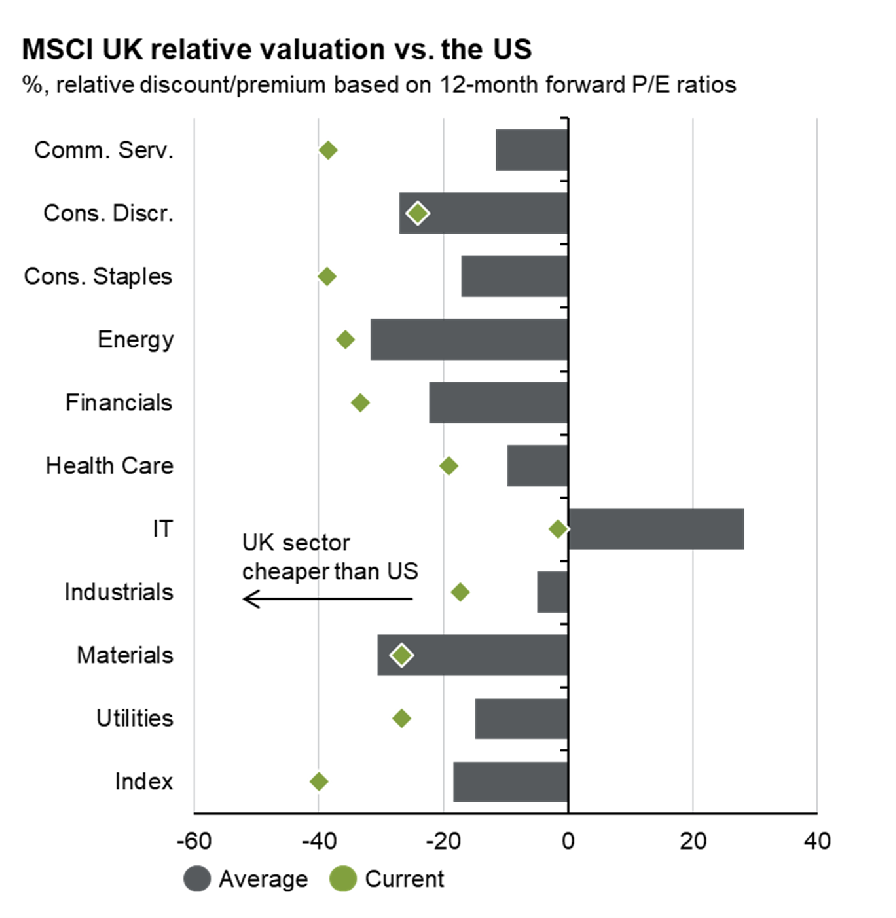
A major factor is value. A comparable company, operating within the same sector, typically trades more cheaply if listed in the UK than in the US. As shown on the graph below, this is currently most prominent within the consumer services sector (business that facilitate global information exchange through telecommunication, media or interactive online platforms) and consumer staples (companies that make/sell essential daily goods.
Source: JP Morgan, 2026
There isn’t a single reason for this, but rather a combination of several structural and cyclical factors, including:
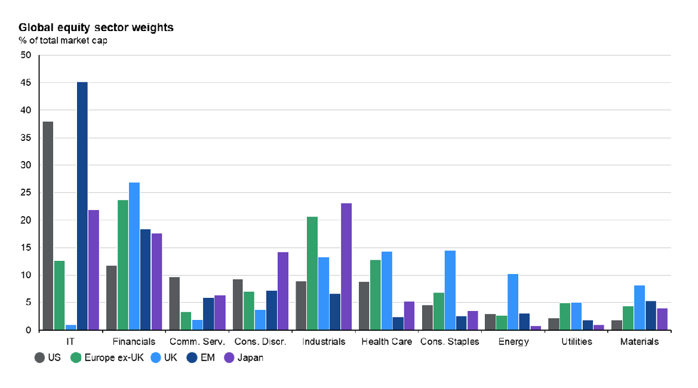
Market make-up: the UK market is dominated by mature sectors including financials, energy and utilities which tend to command lower valuations (given their stability of cash flows) than earlier stage businesses where earnings are growing rapidly in less regulated markets. 38% of the US index is made up of IT names, whereas only 1% of the UK sector is of this sector (5).
Source: JP Morgan, 2026
Sentiment: Investor sentiment towards the UK has been weak for much of the past decade, reflecting the uncertainty surrounding Brexit and an extended period of political instability. Seven Prime Ministers in ten years has done little to inspire confidence, prompting many domestic and international investors to reduce their exposure to UK assets.
Momentum: As the US market, led by a handful of mega-cap technology companies, has outperformed over the past decade, index funds and momentum investors have allocated an increasing proportion of capital to US equities. This has created a self-reinforcing cycle: strong performance attracts more investment, which in turn pushes valuations even higher.
Bowmore portfolios
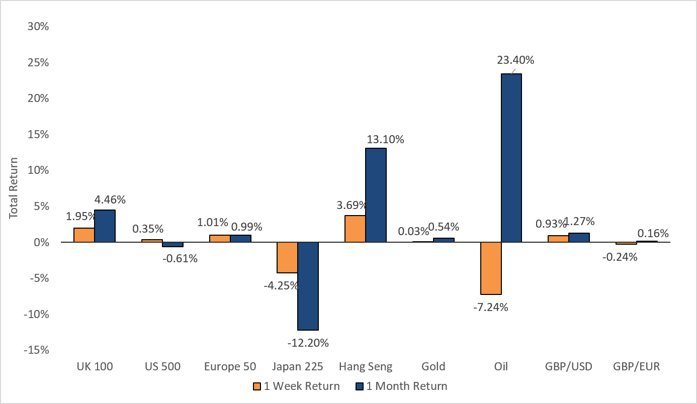
Whilst the steady stream of UK-listed companies leaving the main market is a longer-term concern, we are well positioned to benefit from this trend in the near term. Indeed, this week the UK large cap index hit a record high, helped by the ongoing bidding activity to rise prices6. Albeit, UK-listed companies continue to trade at a discount both to their international peers and to our assessment of their intrinsic value. As a result, takeover bids often come with substantial premiums to prevailing share prices, with share prices typically moving close to the proposed offer level once a bid is announced.
A good example of this approach in practice is Redwheel's UK Equity Income Fund, which is held within our core portfolios. The fund seeks to deliver a dividend yield above that of the UK index while also generating long-term capital growth. It does this by investing in companies that are trading below their estimated fair value. This valuation discipline has contributed to strong performance, with the fund up 10.69% year to date.
Source: AlphaTerminal, data as at 30/07/2026
The value of your investments can go down as well as up, so you could get back less than you invested. Past performance is not a guide to future performance.
Sources:
1 Portfolio Adviser, 2026
2 CNBC, 2026
3 Money Week, 2026
4 Alpha Terminal, 2026
5 JP Morgan, 2026
6 Fidelity, 2026