Important information: The value of investments and any income derived from them may go down as well as up. You may not get back the amount originally invested. Past performance is not a reliable indicator of future results.
- The UK’s last operating coal power station closed down this week
- Renewable energy is now responsible for more than 50% of the UK’s electricity, up from just 7% in 2010
- The UK is still investing and relying upon oil and gas but it is expected that this will reduce by 80% over the next 25 years
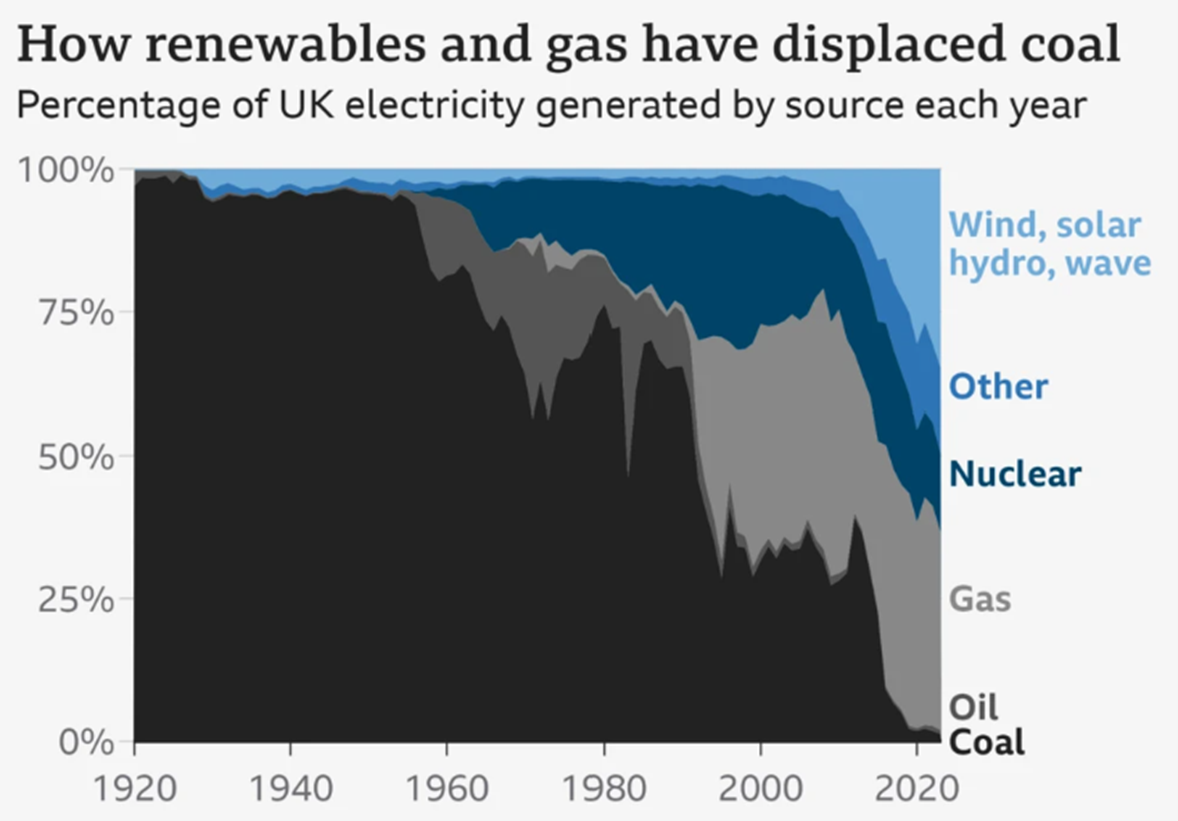 Source: BBC via Department for Energy Security and Net Zero
This transformation has all been part of the UK’s pledge to reduce greenhouse gas emissions to net zero by 2050, a pledge brought about by The Paris Agreement in 2015. 196 parties have now signed The Paris Agreement, committing themselves to this net zero target, but the UK is the first major economy to abandon coal power. It is not, however, abandoning fossil fuels. As the above chart shows, the UK is still very much reliant on gas for its power needs and it fully intends to carry on with this. Sunak said last year ‘even when we reach net zero in 2050, a quarter of our energy needs will still come from oil and gas’. The UK government granted one hundred new North Sea oil and gas licences last year.
This policy undermines the UK’s climate commitments, and its impact is still unclear but it does serve two purposes:
1. Energy Security – the UK is heavily reliant on imports. This has the added benefit that domestically produced gas is four times better from an emissions standpoint than imported Liquified natural gas.
2. Combat the intermittency of renewables - any UK resident knows that there are days or weeks when the sun doesn’t shine. Equally, wind speeds fluctuate significantly across seasons. This is a big hindrance in fully transitioning to renewable energy and the reason why the UK will still use oil and gas in 2050, albeit at just 20% of the level it uses today.
Bowmore Portfolios
We see significant opportunity in Renewable Energy – these assets did tremendously well in 2020 and 2021 as the UK weaned itself off coal and the world’s awareness of climate change improved drastically. Sadly, war, in particular the Russian invasion of Ukraine, disrupted energy supply and the transition to net zero. Taking a long-term view, we expect that these assets will have their moment in the sun once again.
We invest in the Guiness Sustainable Energy Fund that invests in companies involved in everything from solar and wind power to hydrogen and batteries. Battery storage technology has come leaps and bounds and is helping with the intermittency issues. We don’t invest in battery storage technology directly as it remains an incredibly competitive market with an ever-evolving regulatory landscape, but we do think the technology will enable improved reliance, and thus returns, on Renewables.
Source: BBC via Department for Energy Security and Net Zero
This transformation has all been part of the UK’s pledge to reduce greenhouse gas emissions to net zero by 2050, a pledge brought about by The Paris Agreement in 2015. 196 parties have now signed The Paris Agreement, committing themselves to this net zero target, but the UK is the first major economy to abandon coal power. It is not, however, abandoning fossil fuels. As the above chart shows, the UK is still very much reliant on gas for its power needs and it fully intends to carry on with this. Sunak said last year ‘even when we reach net zero in 2050, a quarter of our energy needs will still come from oil and gas’. The UK government granted one hundred new North Sea oil and gas licences last year.
This policy undermines the UK’s climate commitments, and its impact is still unclear but it does serve two purposes:
1. Energy Security – the UK is heavily reliant on imports. This has the added benefit that domestically produced gas is four times better from an emissions standpoint than imported Liquified natural gas.
2. Combat the intermittency of renewables - any UK resident knows that there are days or weeks when the sun doesn’t shine. Equally, wind speeds fluctuate significantly across seasons. This is a big hindrance in fully transitioning to renewable energy and the reason why the UK will still use oil and gas in 2050, albeit at just 20% of the level it uses today.
Bowmore Portfolios
We see significant opportunity in Renewable Energy – these assets did tremendously well in 2020 and 2021 as the UK weaned itself off coal and the world’s awareness of climate change improved drastically. Sadly, war, in particular the Russian invasion of Ukraine, disrupted energy supply and the transition to net zero. Taking a long-term view, we expect that these assets will have their moment in the sun once again.
We invest in the Guiness Sustainable Energy Fund that invests in companies involved in everything from solar and wind power to hydrogen and batteries. Battery storage technology has come leaps and bounds and is helping with the intermittency issues. We don’t invest in battery storage technology directly as it remains an incredibly competitive market with an ever-evolving regulatory landscape, but we do think the technology will enable improved reliance, and thus returns, on Renewables.