

US government debt passed $40 trillion this month, arriving faster than official forecasters had expected, and roughly double what it was ten years ago.
Facing a bond market selloff, the US Treasury responded by buying back more of its own long-term debt to increase liquidity and thereby bring borrowing costs down, but the effect faded within days, and the move drew public criticism.
We continue to favour shorter-dated UK government bonds over longer-dated ones, reflecting our scepticism that either the US or UK has the political will to bring their deficits under control.
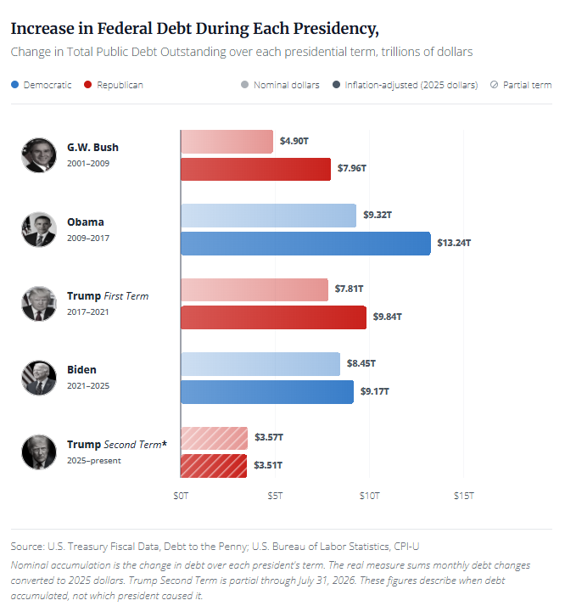
The US national debt surpassed $40 trillion this month, months earlier than the US government's own budget office had predicted just a few years ago[1]. That figure has doubled in the space of a decade[2]. It has grown under presidents of both parties, but the pace has quickened lately; adjusting for inflation, debt rose by $13.2 trillion over Barack Obama's two terms, and Donald Trump has already added more than that across his one-and-a-bit terms[3].
The US government spends more than it collects in tax each year, and the gap for the current year is expected to be $1.9 trillion, or 5.8% of the size of the economy[4] - it was only in 1999 President Clinton celebrated the elimination of the deficit[5]. Some of this yawning deficit is simply the cost of interest on money already borrowed. That interest bill is expected to top $1 trillion this year for the first time, more than the US government spends on defence, and now swallows around one in every five dollars of tax revenue[6].
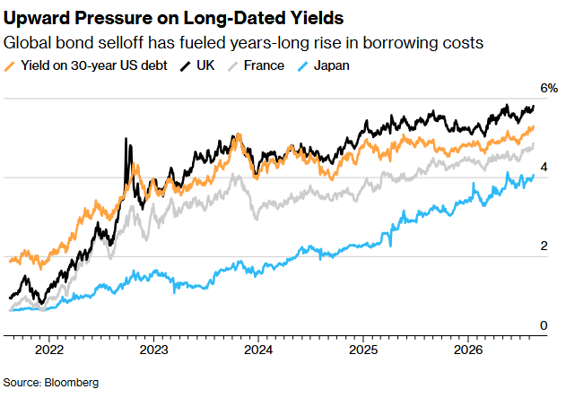
It is this growing bill, more than any single number, that has made investors uneasy[7]. When a government's finances look stretched, investors demand a higher interest rate, or yield, to lend it money, since they are perceived to be taking on more risk. The interest rate on 30 year US government bonds recently reached its highest level in around two decades[8].
A quick fix, not a cure
The Treasury, led by Scott Bessent, responded by significantly increasing the amount of long-term bonds it buys back from the market, in an effort to push their price up and their yield down[9]. To pay for this, it borrows more in the short term. The effect was brief in that yields fell for a day, then rose back to roughly where they started[10]. One commentator described the move as a “band-aid over a bullet hole”[11].
The sharpest rebuke came from Stanley Druckenmiller, the veteran investor who mentored Bessent early in his career. In a Wall Street Journal article, he argued that the buybacks amount to manipulating the price of government debt, and that doing so removes a useful early warning sign of unsustainable borrowing[12]. Bessent has disagreed, describing the purchases as routine housekeeping rather than an attempt to hold rates down[13].
Meanwhile, higher energy prices linked to the conflict involving Iran have kept inflation elevated, and markets now think it’s more likely the Federal Reserve raises interest rates later this year than cuts them[14].
Not just an American problem
The UK faces a similar mismatch between spending and income, albeit without the growth the US economy enjoys. Both countries, and many other Western ones, will need to address the mismatch between spending and borrowing eventually.
UK inflation picked up to 2.9% in July, and markets are currently pricing in a Bank of England rate rise this year[15]. We take a different view; we still think the longer-term underlying trend in UK inflation is downward (Iran notwithstanding) and would not be surprised to see rates cut rather than raised once current pressures ease.
Bowmore portfolios
We do not invest directly in US government debt, nor pick managers for their exposure to US bonds. The only exposure we carry is indirect, through funds such as PIMCO GIS Global Bond, which holds Treasuries because its benchmark requires it.
Instead, our government bond exposure comes through UK gilts, weighted towards shorter maturities, which are generally less volatile whilst still paying a reasonable yield. We are considering extending this a little further, as we think markets have priced in more rate rises than the evidence supports.
Our caution is focused at the long end of the curve, the same part of the market where the US has been actively buying back bonds. Long-dated yields say less about near-term rates and more about whether investors trust a government to keep its finances under control. On that measure, our interpretation is that neither the US nor the UK look convincing, and therefore, we don't believe the yield on offer compensates for the associated risk.
Source: AlphaTerminal, data as at 24/08/2026
The value of your investments can go down as well as up, so you could get back less than you invested. Past performance is not a guide to future performance.
Sources:
1 CNN Business, "National debt reaches grim $40 trillion milestone"
2 CNN Business, "The national debt just hit $40 trillion. But how much is $40 trillion?"
3 Reason Foundation, "Debtor Nation 2026: The $40 trillion national debt"
4 Congressional Budget Office, "The Budget and Economic Outlook: 2026 to 2036"
5 Presidential Libraries
6 Axios, "How the US $40 trillion national debt hits your wallet"
7 Bloomberg
8 Trading Economics
9 U.S. Department of the Treasury, press release, "Treasury Announces Increased Sizes of Nominal Long-End Liquidity 10 Support Buybacks"
10 Trading Economics
11 Irish Times
12 FT Alphaville, "Bessent gets Drucked"
13 Seoul Economic Daily, "Druckenmiller Slams Bessent's Bond Buybacks"
14 J.P. Morgan, "Will the Fed Hike Rates in September?"
15 Trading Economics